Chad
In Chad, HI is delivering an emergency response to refugees fleeing the conflict in neighboring Sudan. HI also works in inclusive education and supports survivors of violence in several provinces across the country
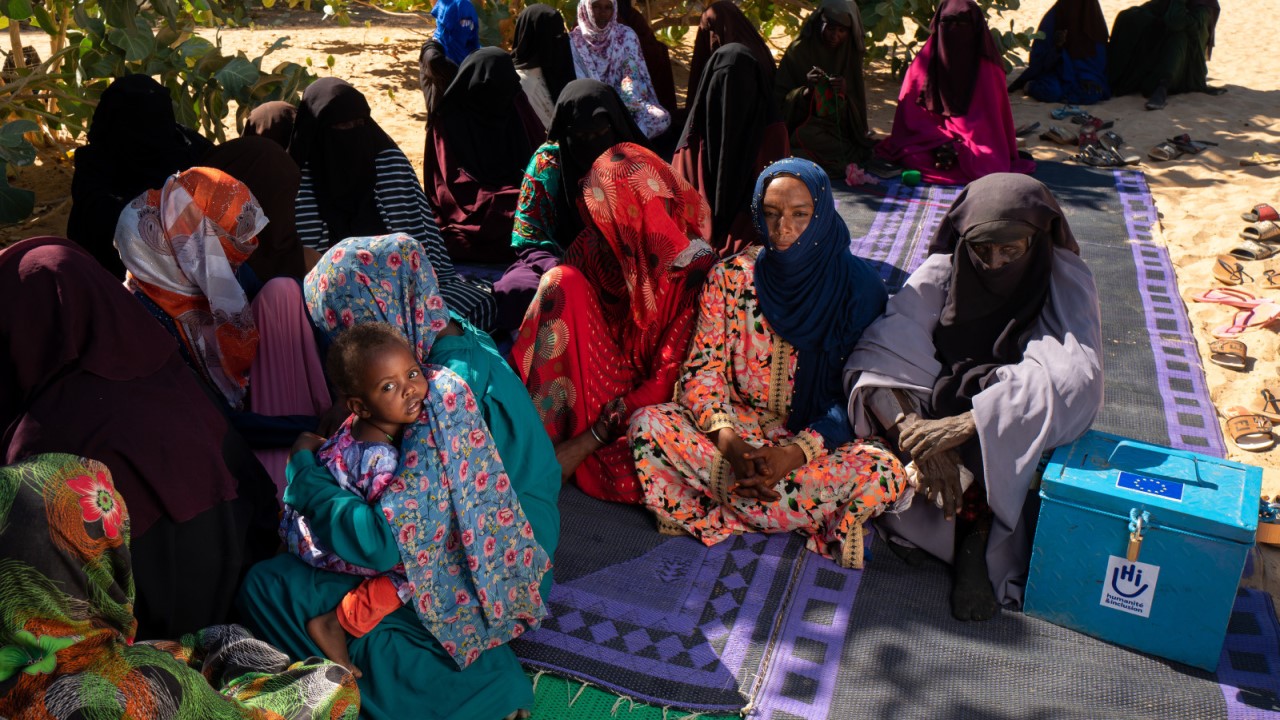
Chad, November 2020. Women wait at an agricultural fair organised by HI in Owoli. | © Gwenn Dubourthoumieu / HI
Our actions
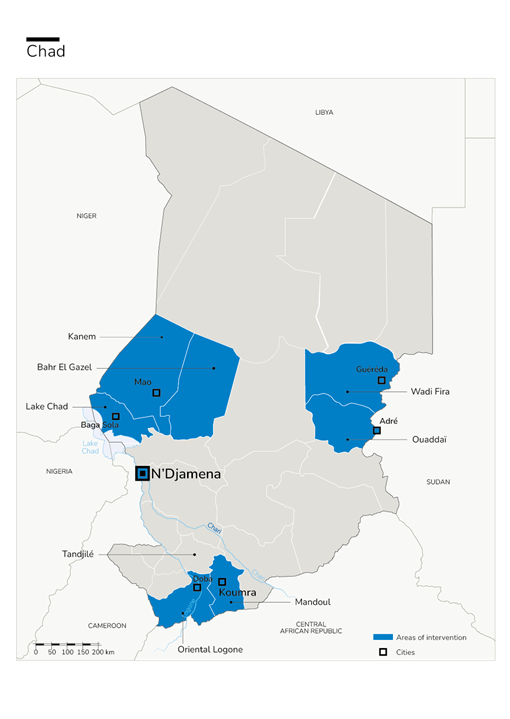
To address the challenges posed by the Sudanese crisis on Chad’s eastern border, HI is working with refugee populations to provide rehabilitation services and mental health support. These activities are being carried out in the provinces of Ouaddaï and Wadi Fira.
Furthermore, HI addresses basic needs in health, nutrition, water, hygiene, and sanitation in Wadi Fira province. Finally, HI is also present in the Adré region, the main transit point for refugees in Ouaddaï province, providing logistical support: Atlas Logistique has made a storage warehouse available to international and local humanitarian organizations for humanitarian supplies, and has also rehabilitated a landing strip to facilitate humanitarian access.
Moreover, HI implements emergency response interventions and development projects, drawing on its core areas of expertise: assistance to survivors of violence and inclusive education in emergency situations. Thus, in several provinces across the country, HI contributes to the education and inclusion of children with disabilities, out-of-school children and girls.
In the provinces of Logone Oriental and Mandoul, HI works on conflict transformation. This involves supporting women to participate in decision-making processes, primarily on conflicts over the region’s natural resources.
Finally, in the capital, N’Djamena, and in Borkou province, HI promotes the social participation and economic inclusion of people at risk, such as people with disabilities and young women.
- Number of HI staff: 102 people
- People directly supported by HI in 2025: 69,762 people
- People indirectly supported by HI’s activities in 2025: 678,468 people
- Program launch date: 2014
Areas of intervention


Latest stories

Mental health in emergencies: the invisible wounds
In Nepal, following the floods at the end of August, 50% - 60% of patients visiting health centers require psychological support; many have lost loved ones.

Djadah & Haleema, refugees in Chad: finding solidarity after violence
Djadah and Haleema fled the violence in their country. Their sadly similar journeys testify to the terrible violence suffered by the people of Sudan.

Now living in Chad, Omran fled the war in Sudan with his family
Omran, a 9-year-old boy from the Darfur region of Sudan, has cerebral palsy. He was forced to flee his home with his family to escape the armed violence.
a life
Background
Chad, a Sahelian country in central Africa with a population of around 21.6 million, is facing a complex humanitarian crisis: mass population movements, climate shocks, regional instability…
The country has been hosting refugees for years. These include people from Darfur in the east – particularly since the conflict that has been raging in Sudan since April 2023 – Central African refugees in the south, and hundreds of thousands of internally displaced people in the Lake Province in the south-west due to recurring violence in the region.
These displacements are increasing pressure on already limited resources, particularly because of climate change: severe droughts, violent floods, and desertification are accelerating the drying up of Lake Chad and reducing the livelihoods of local communities.
As a result, food insecurity is at a critical level: 4.3 million people were acutely food insecure in 2025, and 1.3 million are suffering from malnutrition, particularly in the south and east of the country.
Furthermore, health emergencies, such as cholera epidemics, and inter-communal conflicts in the Lake Chad basin are further exacerbating the population's needs.
Despite the country’s efforts and support from the international community, humanitarian funding remains insufficient: according to the United Nations, only 16% of the 2026 response plan is funded, thereby limiting the response to vital needs and leaving more than 1 million people without assistance.
- Population: 21.6 million
- HDI: 0.416 (2023)
- GDP: USD 19.52 billion (2024)