Our mission
Humanity & Inclusion is a global leader on inclusive health, working to ensure no one is left behind, especially persons with disabilities. Through an approach grounded in human rights, we advocate for quality, person-centred services that are accessible to those facing different types of discrimination.
We combine direct programming with technical assistance to strengthen inclusive health systems, humanitarian coordination, and global policy frameworks at international, regional and national levels. Through community-based solutions, inclusive services, and partnerships with local organisations, we create environments where everyone can access the healthcare they need and live with dignity.
Why does health equity matter?
Today, 1.3 billion persons with disabilities continue to experience lower quality services or find the health and care they need is inaccessible and unaffordable. According to the WHO’s Global Report on Health Equity for Persons with Disabilities (2022), unfair, unjust and avoidable structural conditions affect persons with disabilities disproportionately and result in poorer health outcomes. The right to health of persons with disabilities is consistently violated, and they often encounter barriers to accessing health services, including physical, communication, attitudinal and institutional barriers and less health coverage, directly leading to worse health outcomes.
For example, persons with disabilities are three times more likely to be denied healthcare and four times more likely to be treated badly when accessing services. Per year, more than twice the number of persons with disabilities die than those without disabilities. Achieving Sustainable Development Goal 3 and universal health coverage requires addressing these inequities through people-centred, community-based health systems centred on primary health care – things that benefit everyone.
Our principles
- We use a person-centred approach to guide inclusive, rights-based health programmes.
- We adopt a life-cycle approach to support the health information and services that people need across key stages of life.
- We recognise that planetary health and human health are intrinsically interlinked, and work to promote climate-sensitive approaches across our activities.
- We strengthen health systems to provide equitable, resilient, low-carbon health services and promote quality care and universal health coverage.
- We promote the identification of ‘health in all policies’ to influence the health and equity impacts of policy decisions, enhancing health benefits and avoiding harm.
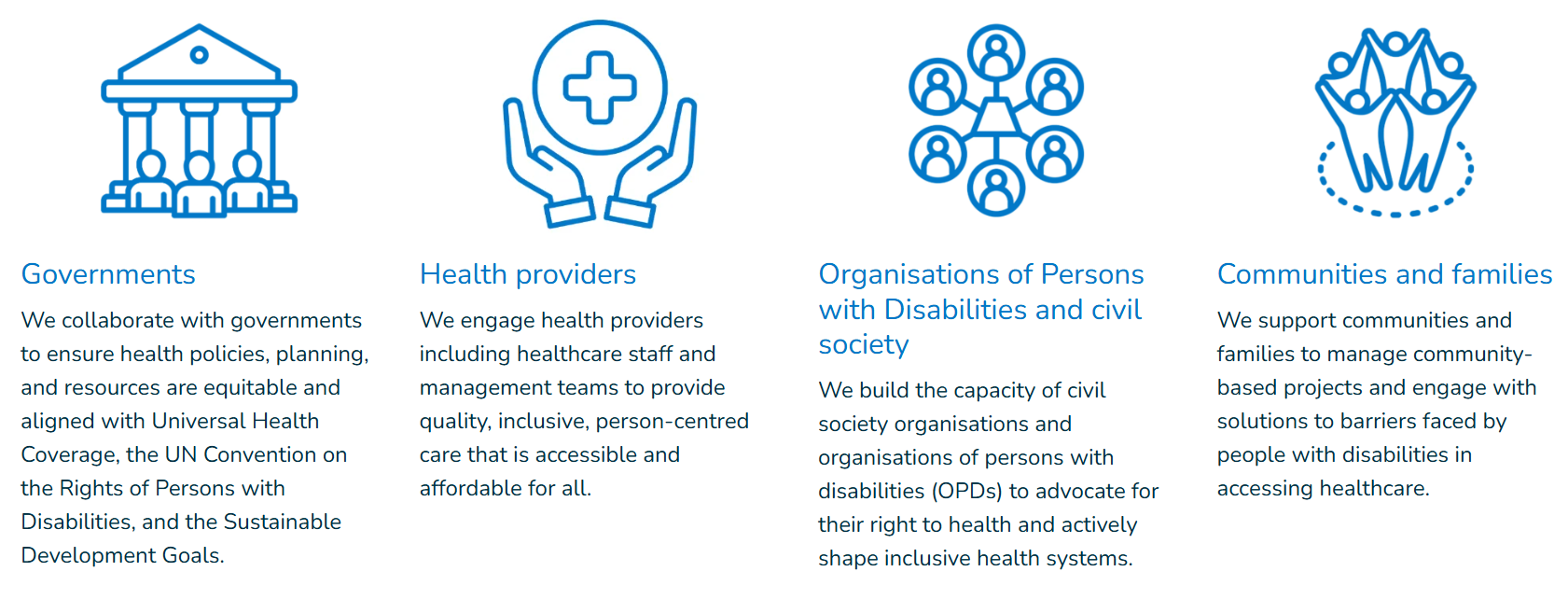
Who we work with
Our projects
Making healthcare inclusive
HI strengthens health systems to ensure that persons with disabilities can access quality, affordable, and respectful care. We focus on removing the barriers to healthcare, and we work to embed disability inclusion in policies, planning, services, workforce development, health information and data collection. By combining system-wide reforms with improvements in service delivery, alongside community engagement and empowerment, we help build health services that are more inclusive, resilient, and responsive to the diverse needs of all individuals and communities.
Our activities include:
- Supporting governments to integrate disability inclusion into health policies, planning, and service delivery, including through the WHO Disability Health Equity Guide for Action .
- Strengthening the leadership and meaningful participation of Organisations of Persons with Disabilities in advocacy on the right to health, such as through our collaboration with Down Syndrome International.
- Engaging in global initiatives that advance health equity, including as a founding member of the WHO Disability Health Equity Initiative.
- Delivering programmes and training packages to strengthen health systems and health service providers, such as our work in Sierra Leone.
Promoting sexual and reproductive health and rights
HI has led inclusive sexual and reproductive health and rights (SRHR) initiatives in 28 countries across Africa, Asia, Latin America, and the Caribbean for over 40 years. We take a holistic approach that supports sexual and general well-being throughout a person’s life. Women and girls with disabilities remain among the most excluded from SRHR services and information, are more likely to be denied their right to bodily autonomy, and face heightened risks of gender-based violence and poor health outcomes.
HI’s inclusive SRHR projects aim to break down barriers and ensure that women and adolescent girls with disabilities of all backgrounds can access the care and information they need. We work closely with Organisations of Persons with Disabilities (OPDs), especially women-led OPDs, to promote equity and inclusion.
Our activities include:
- Developing guidelines for inclusive SRHR through the WISH2ACTION project.
- Developing accessible materials to inform patients and health providers on rights around bodily autonomy, informed consent, and cervical screening.
- Delivering programmes and training packages on inclusive SRHR services to health providers and OPDs, such as our work in Sierra Leone.
Providing mental health and psychosocial support
HI promotes inclusive, community and rights-based mental health and psychosocial support (MHPSS) that strengthens well-being, autonomy, and participation for all, including persons with disabilities and their caregivers. Our approach is interdisciplinary, linking MHPSS with rehabilitation, health, protection, education, armed-violence reduction, disaster risk reduction, and economic inclusion. By doing so, HI ensures that stronger, more sustainable support is provided throughout people’s lives, and that mental health is embedded within systems of care.
We have worked in 34 countries to provide accessible, non-specialised support that can be integrated into everyday services and community systems.
Our activities include:
- Conducting individual and group counselling, peer-to-peer support, awareness-raising, and safe referrals to specialised care.
- Reinforcing the leadership of OPDs, health workers and community organisations, so that quality MHPSS support becomes locally owned.
- Supporting governments to embed MHPSS within national health policies to ensure sustainability beyond individual projects.
Supporting early child development
For over ten years, we have supported Early Childhood Development (ECD) in more than 17 countries, helping young children reach their full potential. Each year, 200 million children do not reach their full potential due to negative impacts of poverty, nutritional deficiencies, and inadequate learning opportunities.
ECD covers the crucial early years, from conception to age 8, when children’s brains and bodies grow rapidly. Our programmes focus on preventing developmental delays and disabilities, identifying them early, and providing timely interventions and support for caregivers. By promoting nurturing care, which includes health, nutrition, protection, early learning, and responsive interaction, we empower families, communities, and health services to create safe, stimulating environments where children can thrive and meet key developmental milestones.
Promoting equitable access to non-communicable disease prevention and treatment
Non-communicable diseases like heart disease, stroke, and diabetes cause 71% of global deaths each year. People with disabilities are three times more likely to develop such conditions. We raise awareness with health providers, improve access to care, and through inclusive programmes, help communities prevent and manage these health conditions, especially in low-resource settings.
Highlighting planetary health and climate-resilient prevention and care
We recognise that human health depends on a healthy planet. Climate change, pollution, and biodiversity loss disproportionally impact persons with disabilities, women, youth and older adults with health conditions.
HI has adopted the Planetary Health approach, envisioning joint benefits for health and climate. This includes promoting nature-based solutions, climate resilient health facilities, and climate-smart health providers and future-proofed services to ensure everyone’s right to a clean, healthy, and sustainable environment.