Madagascar
HI works in Madagascar to improve rehabilitation care, inclusion, mental health, and the protection of impacted groups, and to build resilience to climate-related disasters.

Madagascar, 2023. Little girls at a special school for deaf and/or hard-of-hearing children play during break time. | © Rakotondraparany D. Njara / HI
Our actions
HI has been working in Madagascar for nearly 40 years. After establishing several prosthetics centers and rehabilitation projects, the organization now focuses on improving access to rehabilitation care, education, economic inclusion services, and social protection for people with disabilities and other groups by promoting their social participation and defending their rights.
HI also works in the field of mental health, supporting people experiencing psychosocial distress or suffering from mental health conditions. More specifically, the organization implements projects within prisons to improve prisoners’ living conditions, health, and reintegration. This work also aims to change practices within prison facilities.
HI promotes and protects the rights of children in conflict with the law. It works to strengthen service quality and the capacities of the Ministry of Justice, including the prison service and institutions responsible for child protection and prevention.
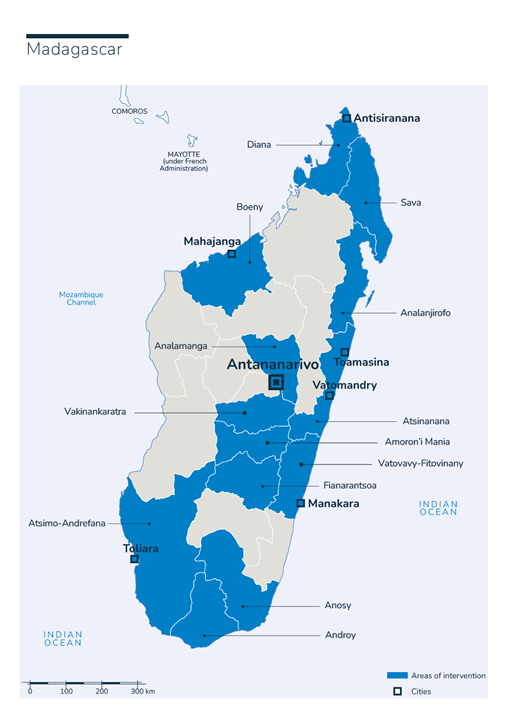
HI strengthens logistical capacities and optimizes humanitarian access to ensure an effective response in the regions of Atsimo-Andrefana, Androy and Anosy. To achieve this, HI produces and provides logistical analyses to humanitarian and government actors to support informed decision-making. It also conducts technical assessments of road infrastructure and strengthens emergency preparedness by pre-positioning response kits and training on road rehabilitation.
Finally, HI is strengthening the resilience of populations at risk of drought and associated risks in the Greater South of Madagascar by promoting, harmonizing, and developing an inclusive, impact-focused early warning and response mechanism. To achieve this, the program aims to strengthen synergies and complementarity between early warning systems and key stakeholders to ensure effective, integrated, needs-based early action tailored to impacted communities. The organization also aims to embed inclusion in early action and humanitarian responses, ensuring that the specific needs of all population groups are taken into account.
- HI staff: 90
- People directly supported by HI in 2025: 29,682
- People indirectly supported by HI in 2025: 140,020
- Program launch date: 1987
Areas of intervention


Latest stories

Madagascar: HI supports the survivors of Cyclone Fytia
Thanks to financial aid, people affected by the disaster can cover their basic needs and rebuild their lives.

Cyclone Gezani hits Madagascar: HI supports victims
10 days after Cyclone Fytia swept across Madagascar, the even stronger Cyclone Gezani destroyed much of the port city of Toamasina. HI has mobilized its teams to provide emergency assistance.

In Madagascar, Odile is striving for more inclusive cyclone risk management
Odile, a survivor of cyclone Gamane, which ravaged northern Madagascar at the end of March 2024, is calling for more inclusive management of climate disaster risks.
a life
Background
Madagascar remains one of the world’s poorest countries, with a fragile economy characterized by high public debt, limited infrastructure, and high risk of rising food and energy prices. Poverty rates remain very high, and many households continue to struggle to meet their basic needs. Living conditions are particularly difficult for affected groups, notably people with disabilities, who are often exposed to discrimination, have limited access to education and employment, and are excluded from social and economic life. This significantly restricts their independence and participation in society.
Madagascar is also increasingly affected by climate change and recurrent natural disasters, particularly cyclones, droughts and floods. These shocks regularly create severe humanitarian needs, including population displacement, food insecurity, and infrastructure damage. Each disaster strains already limited national resources and slows long-term development.
Consequently, humanitarian needs remain high and building resilience is a key priority. Efforts are increasingly focused on improving disaster preparedness, adapting to climate change, and promoting inclusive development to ensure that no one is left behind, particularly the most impacted populations
- Population: 32.32 million
- HDI: 0.487 (2023)
- GDP: 21.19 billion dollars
- GDP per capita: US$655