Philippines
In the Philippines, HI provides multi-sectoral support to communities affected by climate change. The organization also supports the employability and economic empowerment of youth with disabilities and carries out initiatives to improve care for young people with type 1 diabetes.

Destruction in Leyte province following typhoon Haiyan | © B. Blondel / HI
Our actions
In the Philippines, facing the increasing frequency and severity of climate-related risks, HI has worked for several years to preserve dignity and strengthen the resilience of populations most at risk from climate-related disasters and natural hazards such as typhoons, floods, and earthquakes.
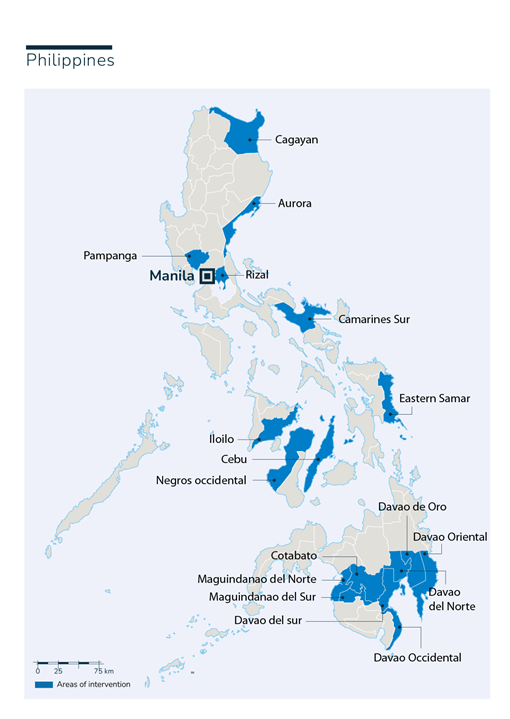
In the Cagayan Valley, Bicol, Eastern Visayas, and BARMM regions, HI works to provide effective anticipatory action and humanitarian aid, adopting a participatory and inclusive approach regarding age, gender, and disability. This includes risk awareness activities, support for identified organizations of people with disabilities, and advocacy with local institutions to ensure that the interests of those in need are considered in the humanitarian response.
HI also addresses the needs of the most affected populations—such as people with disabilities, older people, women and children—in terms of food security, shelter, water and sanitation, health and protection. Finally, the organization conducts psychological first aid and supports efforts to ensure the population has access to quality psychosocial support services, enabling them to cope with trauma.
Furthermore, HI is part of a consortium of humanitarian organizations working with government agencies and local, national, and community-based civil society organizations to strengthen preparedness mechanisms for communities most at risk of flooding, to ensure that no one is left behind when an emergency strikes the country.
In addition, HI builds inclusive employment pathways for youth with disabilities in Metro Manila and the CALABARZON region, providing training in job and business readiness skills to develop a career or business plan.
Finally, the organization works to improve access to inclusive healthcare services and information for children and young people under 25 with type 1 diabetes. The project aims to ensure access to appropriate resources for understanding and managing the condition, enable professionals to care for patients, create a network of inclusive healthcare facilities, and ensure patients have access to insulin, blood glucose test kits, and other necessary medical supplies.
- HI staff: 45 people
- People directly supported by HI in 2025: 17,747 people
- People indirectly supported by HI in 2025:199,567 people
- Program launch date: 1985
Areas of intervention


Latest stories

HI helps earthquake survivors in the Philippines regain their independence
Memoración and Vena were forced to spend their nights in precarious conditions. HI provided them with proper sleeping facilities, mobility devices, and rehabilitation care.

Emergency in the Philippines: plunged into chaos once again
For the 20th time in 2025, the Philippines is facing an extremely violent typhoon. Kalmaegi is the deadliest of the year, with catastrophic consequences.

Floods in the Philippines: Tintin wants to be an inspiration to her children
After weeks of rain and flooding, Tintin found support from HI. Today, she and her family are rebuilding their lives and moving forward.
a life
Background
Located in Southeast Asia, the Philippine archipelago is one of the most hazard-prone regions on the planet; the country is facing a significant crisis, mainly driven by an unprecedented succession of climate-related disasters.
In 2025, the country was hit by 20 typhoons, the deadliest of which, Kalmaegi, made landfall in November with winds reaching 170 km/h, causing devastating floods, landslides, and mudslides. This single event alone claimed nearly 200 lives, left hundreds missing, and displaced more than 600,000 people, including many families who had lost everything. This situation is part of a broader context of intensifying climate change, which is increasing the strength and frequency of typhoons. The monsoon season was particularly intense in 2025: millions of people were affected, entire towns were submerged, and there was massive destruction of homes and infrastructure. The most impacted populations, such as people with disabilities, are particularly at risk, with a mortality rate two to four times higher in the event of a natural disaster.
Mass displacement and the destruction of livelihoods exacerbate precarious living conditions. Overwhelmed by the situation, Philippine authorities are struggling to provide sustainable solutions. Planned relocations to move communities away from high-risk areas raise numerous concerns, particularly for people with disabilities, who are often excluded from consultations and rehoused in inaccessible sites or those lacking basic services.
Although local and international organizations are mobilizing to assist affected populations, needs remain immense, and communities' resilience is being severely tested, with years of reconstruction ahead.
- Population: 117.7 million
- HDI: 0.720 (2023)
- GDP: USD 461.6 billion (2024)
- GDP per capita: approximately USD 4,000 (2024)