Sudan
In Sudan, HI works with people with disabilities and communities to meet their basic needs. We also provide rehabilitation services and promote a more inclusive approach to disability within the humanitarian community.
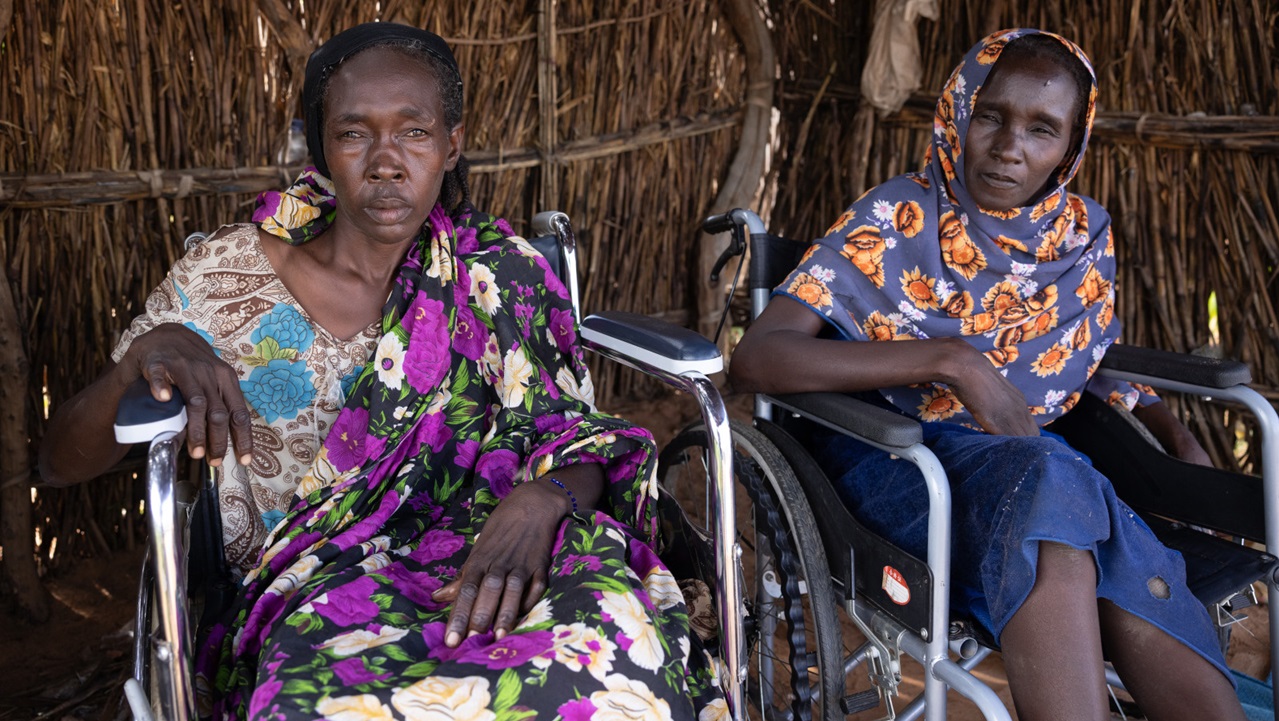
Kaltouma Ismail Abdullah, 35, and Hassaneih Ismail Abdullah, 25, are sisters from Al Kuraynik, in the Darfur region of Sudan. They both have disabilities, are partially blind, and now live in Aboutengué refugee camp after fleeing conflict in Darfur region | © T. Nicholson / HI
Our actions
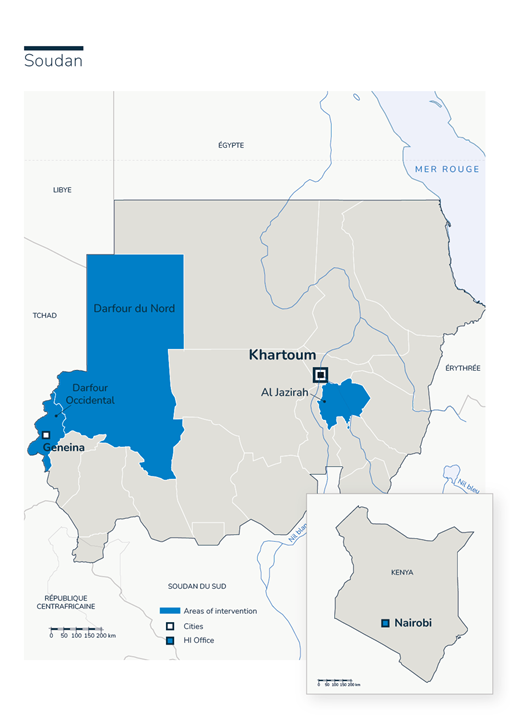
In the west of the country, in Darfur, HI organizes cash aid distributions for households in need, particularly those with children suffering from severe acute malnutrition. This aid strengthens the resilience of families affected by the conflict by enabling them to meet their immediate food needs while supporting the local economy. Furthermore, HI is working to reduce health risks associated with waterborne diseases, such as cholera, by organizing the distribution of hygiene kits and running public awareness campaigns. HI is also active in the Tawila region (North Darfur) to ensure humanitarian aid reaches even the most remote areas – this involves managing the storage of humanitarian aid, ensuring it is transported as close as possible to those in need, and supporting the humanitarian community with their logistical challenges. In addition, HI carries out functional rehabilitation activities within communities and through health facilities run by international NGOs. This involves setting up specialized physical therapy services and establishing a workshop for the manufacturing of mobility aids.
In the states of Al-Jazirah and Khartoum, in eastern Sudan, HI works as part of a consortium with other humanitarian organizations to ensure rapid access to life-saving aid in several key sectors. HI contributes to this project through physical and functional rehabilitation activities for people with disabilities and those who have been injured, as well as stimulation therapy for children suffering from severe acute malnutrition. HI also provides mobility aids, such as crutches, walking sticks and wheelchairs, to people who have difficulty moving around. HI also carries out mine clearance activities in the Khartoum region, mass media campaigns to educate people about the risks of explosive devices, and the establishment of a victim assistance system.
Furthermore, across the country, HI emphasises inclusive humanitarian action by supporting its humanitarian partners to strengthen the inclusion of people with disabilities, thereby contributing to equitable access to humanitarian aid. At the global level, HI co-chairs the ‘Age and Inclusion’ working group within the United Nations Humanitarian Coordination Mechanism. There, we promote standards on the inclusion of people with disabilities in humanitarian action, as defined by the United Nations Inter-Agency Standing Committee in 2019, and an approach that takes into account disability, age, and gender. The main areas targeted are health, protection, and food security.
- Number of HI staff: 67
- People directly supported by HI in 2025: 7,560 people
- People indirectly supported by HI’s initiatives in 2025: 34,170 people
- Program launch date: 2024
Areas of intervention


Latest stories

Sudan: Stimulation therapy helps Sadia’s children overcome the effects of malnutrition
21.2 million Sudanese people are facing acute hunger due to the war.¹ For young children, this heightens the risk of lasting developmental delays.

HI provides emergency rehabilitation care to war victims in Sudan
Three years after the outbreak of the war, the Sudanese population continues to endure extreme violence.

In Darfur, aid workers face the consequences of violence
Jérôme Bertrand, head of deployments for Atlas Logistique, travelled to Sudan in late 2025 for an assessment mission in the town of Tawilah, in Darfur.
a life
Background
Sudan, Africa’s third-largest country with a population of nearly 54 million, has been embroiled since April 2023 in a devastating armed conflict between the Sudanese Armed Forces (SAF) and the Rapid Support Forces (RSF). This conflict, characterized by extreme violence (bombings, sieges, attacks on civilians), has caused an unprecedented humanitarian disaster: more than 13 million people have been displaced, with over 9 million internally displaced, making Sudan the scene of the world’s largest internal displacement crisis. Furthermore, in 2025, more than 33 million people were in need of humanitarian aid (an increase of 3 million compared with 2025) – in April of that year, the United Nations described this crisis as the most serious in the world.
The situation in the country is exacerbated by economic collapse and the destruction of infrastructure (health, water, agriculture, energy, education, etc.). In 2026, 24.6 million Sudanese people were suffering from acute food insecurity, particularly in Darfur and Kordofan, where famine had become widespread. Children are particularly affected: more than 21 million (45 per cent of the population) are acutely food insecure, and hundreds of thousands are suffering from severe malnutrition.
Women, children, people with disabilities and the elderly, are particularly exposed to all forms of violence. Despite the efforts of humanitarian organizations to reach the most remote areas of the country, significant access constraints – particularly in areas of active conflict – as well as funding constraints continue to hinder the delivery of aid where it is most needed. As a result, humanitarian workers are also being targeted; 130 were killed in 2025, and despite a funding appeal of $2.9 billion launched by the United Nations for 2026, only 16% has been funded, jeopardizing the emergency response.
- Population: 53.8 million
- HDI: 0.511 (2023)
- GDP: 49.7 billion (2024)
- GDP per capita: 984 USD (2024)