Uganda
In Uganda, HI works with refugees and host communities to facilitate their access to psychosocial support, rehabilitation care, education.
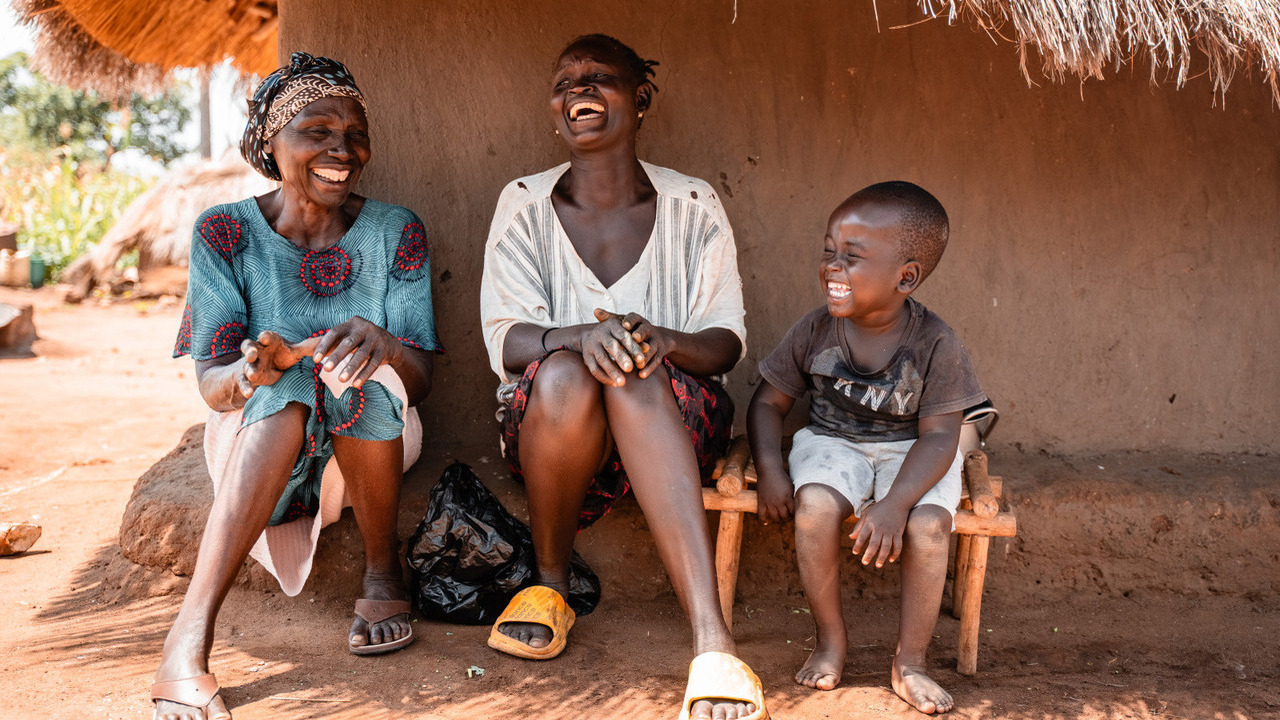
Jojo sitting with his grandmother and his mother. | © Crolle Agency / HI
Our actions
HI works with refugees with specific needs, such as people with disabilities, older people, single mothers with children or unaccompanied children, facilitating their access to services in the refugee camps. As many of these people have witnessed traumatic events or suffered severe shock, HI provides psychosocial support in the form of individual or group discussion sessions and other mental health services. The teams also train care professionals to meet the needs of these patients. HI implements project outside of refugee settlement to support communities in urban and rural areas (especially people with disabilities, girls and teenagers, survivors of violence…)
In the refugee settlements, where access to healthcare is difficult, HI provides physical rehabilitation services to help people with disabilities increase their autonomy. More specifically, the program provides mobility aids (walking sticks, wheelchairs, etc.) and runs an innovative project to produce prostheses and orthoses using 3D printers. These made-to-measure devices enable people to regain their mobility.
HI also works with refugee children to promote education services and ensure that children with disabilities can attend school. Our teams train teachers in inclusive teaching methods, distribute school materials adapted to the children's needs, and run awareness-raising sessions in the communities. In the West Nile region, HI Uganda is also developing early childhood projects for very young children with disabilities or children at risk of developmental disabilities. These projects involve supporting the children’s parents and relatives and training them in good care and educational practices.
HI is also working in the field of sexual and reproductive health, raising young girls' awareness of their rights and teaching them good menstrual hygiene practices. The teams also train community and health workers to take these issues into account. More broadly, HI is working with other organizations and actors in Uganda, training them in disability issues, thereby helping to ensure that the needs of people with disabilities are included in all actions undertaken in the country.
HI is also actively involved in the prevention and response to gender-based violence by strengthening the capacity of secondary schools, health workers, and community actors to address gender-based violence through an inclusive and disability-sensitive approach. Overall, the organization promotes safer learning environments, works to challenge harmful social norms, and supports the development of a sustainable and inclusive model for preventing and responding to gender-based violence.
HI responds to emergencies, especially Ebola outbreak through mental health activities and inclusive health activities.
Lastly, HI aims to reinforce the Assistive Technology sector by increasing access to suitable devices while also building skills and creating employment opportunities within the sector. Through training young people and promoting innovation in Assistive Technology, HI works to open up new economic pathways in a growing and emerging field.
- Number of HI staff: 106
- People directly supported by HI in 2025: 166,133 people
- People indirectly supported by HI’s actions in 2025: 3,547,078 people
- Program opened in: 2009
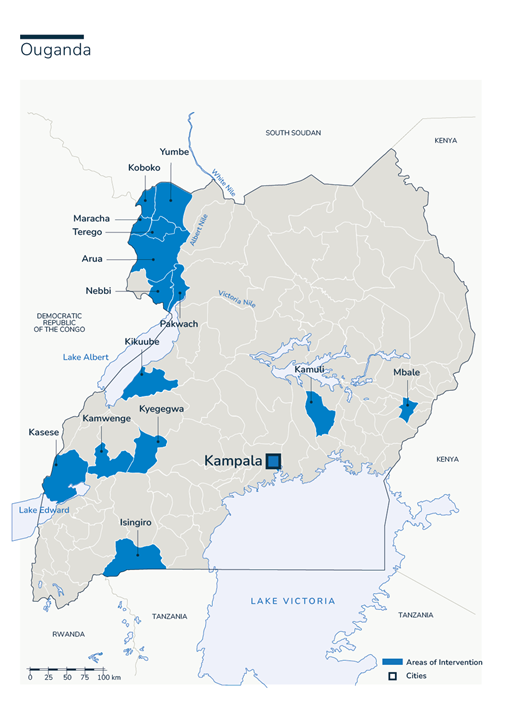
Areas of intervention


Latest stories

HI mobilizes to respond to the Ebola outbreak in the DRC and Uganda
Through logistical support, hygiene supply distribution, and public awareness campaigns, HI is taking action to contain the Ebola outbreak in the Democratic Republic of the Congo and Uganda.

In Uganda, people with disabilities are largely overlooked by humanitarian aid
Thousands of refugees with disabilities have been excluded from food aid. This silent crisis is worsening every day.

Mushange’s journey to education in Uganda
Mushange, 13, lives in Uganda. She is full of big dreams and determination. Thriving at school and making new friends, she's looking to the future with hope and confidence.
a life
Background
The humanitarian situation in Uganda is shaped by a combination of rapid population growth, poverty, climate-related shocks, and large-scale displacement from neighboring countries such as South Sudan, Democratic Republic of Congo, and Sudan. Uganda currently hosts over 2 million refugees, making it the largest refugee-hosting country in Africa. While the country is widely recognized for its inclusive refugee policies, the humanitarian system is under growing strain due to limited funding, overcrowded settlements, and rising needs in both refugee and host communities.
Within this context, many groups are disproportionately affected, particularly persons with disabilities, older people, women, and children. Many refugees and Ugandans face food insecurity, limited access to healthcare, and inadequate shelter. In drought-prone regions such as Karamoja, climate change and repeated poor harvests further increase hardship, leaving families dependent on humanitarian assistance to meet basic needs.
Persons with disabilities face additional and often severe barriers. Access to humanitarian services is frequently limited due to physical inaccessibility of facilities, lack of assistive devices, communication barriers, and insufficient inclusion in aid programs. Health centers, schools, and distribution sites are often not designed to accommodate people with mobility, visual, hearing, or intellectual disabilities. As a result, persons with disabilities are at higher risk of exclusion from food distribution, healthcare services, education, and livelihood opportunities.
- Population: 49.71 million
- HDI: 0.582 (2023)
- GDP: USD 73.37 billion
- GDP per capita: USD 1,480
Reports
The latest publications
> Avoiding Harm, Respecting Rights: Facilitating Person-Centered Disability-Inclusive Informed Consent in Sexual and Reproductive Health Settings (pdf, 1.36 MB)More > News