Morocco
HI shares its expertise with Moroccan organizations to promote the inclusion of people with disabilities in society and improve the quality of life of migrant populations.
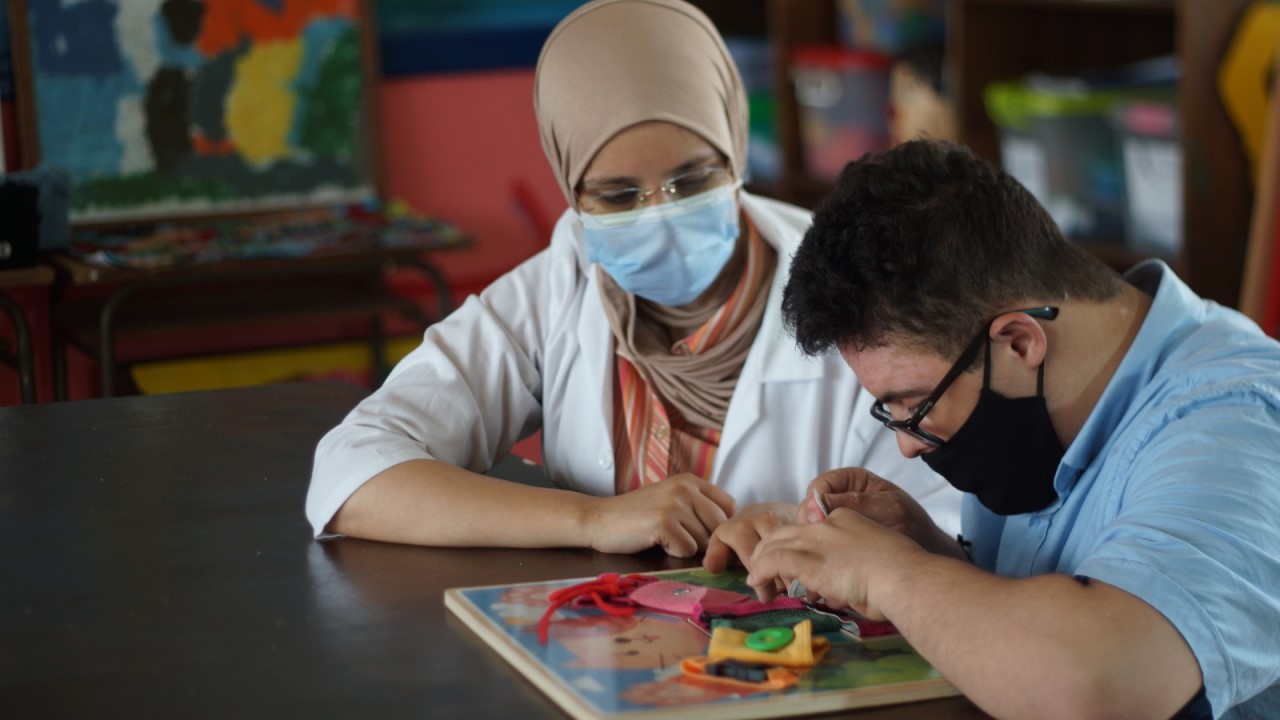
An occupational therapist works with a disabled child in Salé. They work on recreational activities to improve the child's motor skills. | © H.Zahir / HI
Our actions
HI began working in Morocco in 1993 and signed a Headquarters Agreement with the Moroccan Ministry of Cooperation and Foreign Affairs in 1999. The organization’s historical roots are reflected in its strong network of partnerships with Organizations of People with Disabilities (OPD) and other civil society organizations, which it has supported for over 20 years to build their capacity for self-representation and action. HI works through two main pillars: strengthening civil society organizations' institutional, organizational, and financial capacities, and improving their participation in public policy through structured multi-stakeholder dialogue and networking.
Since 2011, HI Morocco has worked closely with authorities on reforms to develop inclusive public policies. The program has also extended its collaboration to the private sector, helping companies to include people with disabilities in the workplace, particularly young people. HI promotes inclusive career guidance for young girls and people with disabilities by providing inclusive vocational training, personalized support, and opportunities for decent employment or self-employment, and by raising awareness of inclusion.
HI strengthens the protection, resilience, and socio-economic inclusion of migrants, with particular attention to people with disabilities and other at-risk groups. The organization supports a medico-psycho-social approach that combines outreach, access to basic services, and psychosocial support, including mental health care, to reach the most excluded individuals. The project also promotes economic empowerment through skills training, coaching, and income-generating opportunities, while improving coordination between local actors and services.
- Number of HI staff: 55
- People directly supported by HI in 2025: 4,562 people
- People indirectly supported by HI’s activities in 2025: 5,759 people
- Program launch date: 1993
Our areas of intervention:
- Rabat-Salé-Kénitra
- Tangier-Tétouan-Al Hoceima
- Casablanca-Settat
- Marrakech-Safi
- Souss-Massa
Areas of intervention


Latest stories

Earthquake in Morocco: post-emergency physical rehabilitation
Present in Morocco since 1993, HI is working alongside its partners to provide physical rehabilitation assistance to the survivors of the earthquake that hit the country in September 2023.

Good news in February at HI: demining in Senegal, inclusive development in Venezuela, post-emergency rehabilitation in Morocco and advocacy in the Philippines.

Morocco: At earthquake's epicenter, communities are healing together
Mohamed lives in Amizmiz, close to the epicenter of the earthquake that hit Morocco. He talks about how solidarity is helping to meet the challenges of this crisis.
a life
Background
Morocco continues to experience moderate economic growth, though climate-related shocks continue to affect it. A prolonged drought and rising structural water stress continue to heavily affect the agricultural sector, a key source of employment and income, particularly in rural areas. While non-agricultural sectors—such as industry, tourism, and telecommunications—have shown relative resilience, structural inequalities persist across regions and population groups, particularly in rural areas and among disproportionately impacted households. Morocco is also a country of transit and destination for migrants and refugees, many of whom live in precarious conditions with limited access to basic services and legal protection. Humanitarian actors highlight the need to strengthen inclusive policies, so populations in need are not left behind.
The situation of people with disabilities remains a key concern. Although Morocco has committed to improving inclusion and has developed legal and policy frameworks aligned with international standards, significant barriers persist in practice. People with disabilities face limited access to education, employment, and healthcare services, as well as physical and social obstacles that restrict their full participation in society.
Access to rehabilitation services and assistive devices remains uneven, particularly in rural and underserved areas. In addition, people with disabilities—especially women, children, and migrants—are at increased risk of exclusion, poverty, and violence. In emergency contexts, such as natural disasters, they are often disproportionately affected and may struggle to access humanitarian aid.
- Population: 38.05 million
- HDI: 0.710 (2023)
- GDP: USD 194.33 billion
- GDP per capita: USD 5,110