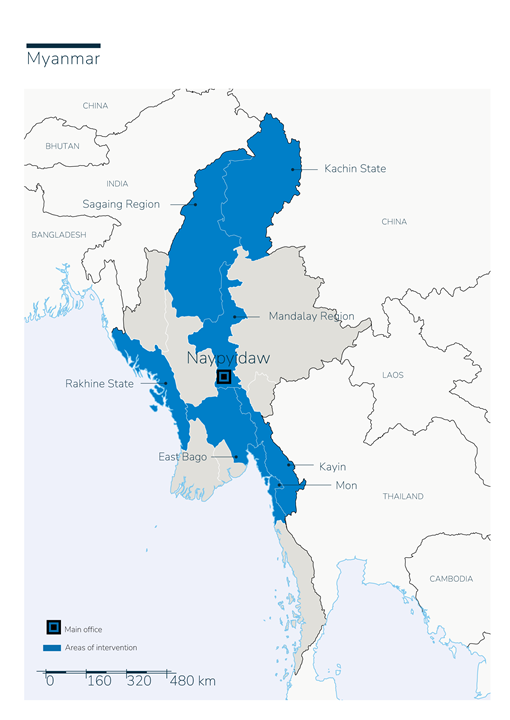
Myanmar
In Myanmar, HI supports people affected by humanitarian crises by helping them access humanitarian aid. HI prioritizes urban and peri-urban areas, especially Yangon and Southern Shan State, for disability-related issues.
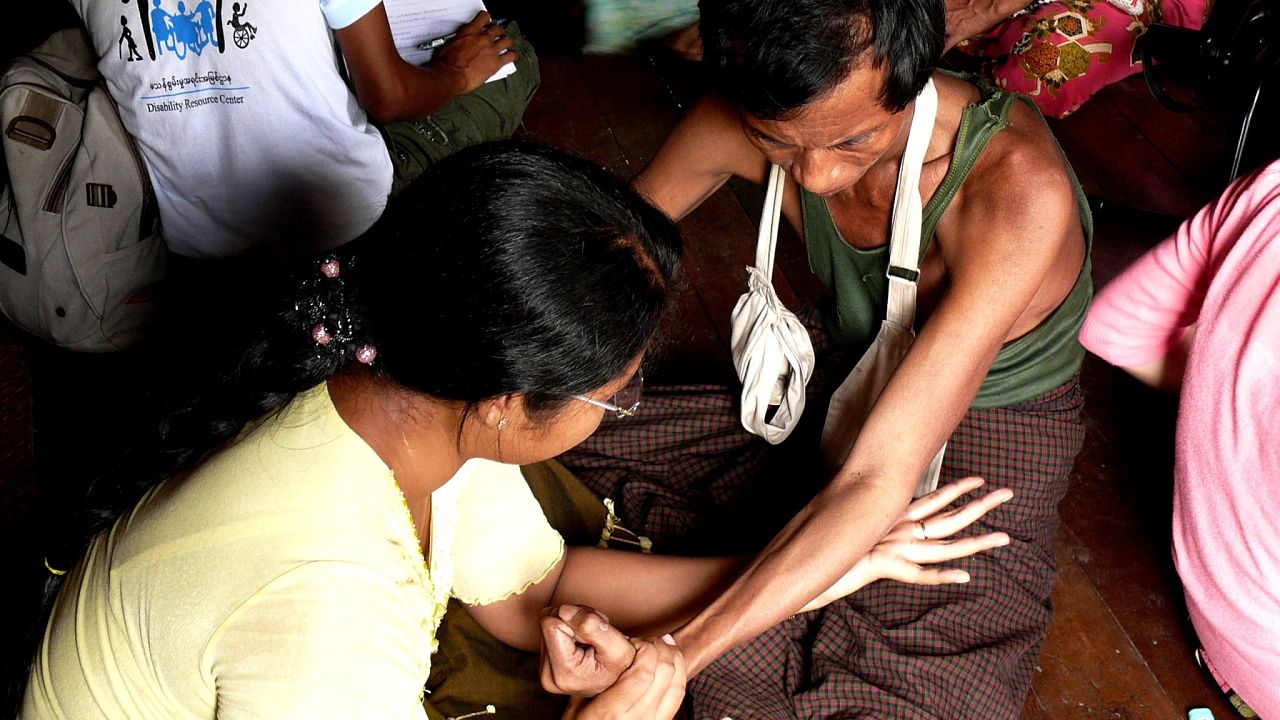
Physical rehabilitation session - Humanity & Inclusion Myanmar | © T. Calvot / HI
Our actions
In Myanmar, HI aims to serve at-risk communities. Given the country context, HI’s operations primarily focus on humanitarian responses for conflict-affected communities, including internally displaced persons (IDPs) living in camps and those residing in informal displacement sites. HI also works closely with host communities to address their needs and mitigate the additional pressures caused by displacement.
The program adopts a mixed implementation modality:
- Direct implementation by HI teams, and
- Implementation through local partner organizations.
This approach enables HI to expand its operational reach and improve access to affected populations. Working with local partners has been particularly important for reaching communities in hard-to-reach areas, including locations with access constraints and restricted areas where international presence may be limited. Through this combined modality, HI seeks to ensure timely, inclusive, and context-sensitive humanitarian assistance for populations most in need.
Through static and mobile clinics, HI teams provide physical rehabilitation and Mental Health and Psychosocial Support (MHPSS) services to conflict-affected communities. Physical rehabilitation services include physical therapy, assistive devices, referrals for prosthetic services and specialized health care, and training and guidance for caregivers to support continued care at home. MHPSS services are delivered through both group-based and individual sessions to address the psychological and social impacts of displacement and conflict. For advanced or specialized care, we refer people we serve to external service providers.
In addition, HI supports at-risk communities in meeting basic needs by providing food, shelter assistance, non-food items (NFIs), and WASH materials, including hygiene kits. HI also provides Multi-Purpose Cash Assistance (MPCA) to enable affected populations to meet their most urgent needs in a flexible and dignified manner.
At the national level, HI contributes to a stronger, more inclusive humanitarian response by leading and supporting the development of standards, guidelines, and toolkits that serve as references for humanitarian actors to mainstream disability inclusion across sectors. Inclusive education is another key area of HI’s work in Myanmar, where HI provides technical assistance and capacity strengthening to international and national education actors, as well as community-based education actors, to promote mainstreaming disability into education services. With a specific focus on people with disabilities, HI also facilitates access to livelihood opportunities for people with disabilities and households with members with disabilities, supporting their economic inclusion and resilience.
Given the high contamination of Explosive Ordnance (EO) and Explosive Remnants of War (ERW) in many areas of the country, HI integrates Explosive Ordnance Risk Education (EORE) into its programming to raise awareness and reduce risks among affected communities.
The program maintains close coordination and collaboration with local authorities, international and national humanitarian actors, civil society organizations (CSOs), and communities to ensure an effective and coordinated humanitarian response.
- Number of HI staff: 93
- People directly supported by HI in 2025: 75,355 people
- People indirectly supported by HI’s activities in 2025: 233,841 people
- Program year opening: 2013
Areas of intervention


Latest stories

Earthquake in Myanmar: More than 55,000 people assisted by HI after the disaster
One year after the earthquake that struck Myanmar in March 2025, the situation remains fragile: HI has provided support to tens of thousands of people in the regions hardest hit by the disaster.

Myanmar Earthquake: HI's response continues 3 months later
On March 28, a 7.7-magnitude earthquake hit the center Myanmar. HI mobilized immediately. Three months later, our teams are still working with affected communities.

Myanmar: HI's vital support for earthquake survivors
While thousands of people displaced by the earthquake in Myanmar are living in improvised shelters and camps, HI's mobile teams are responding to the most urgent needs.
a life
Background
Myanmar has entered its fifth year of nationwide armed conflict following the February 2021 military takeover. Localized confrontations have evolved into a fragmented civil war marked by airstrikes, drone warfare, artillery shelling, and the collapse of public institutions. In 2026, over 16 million people, around one-third of the population, are estimated to require humanitarian assistance, while insecurity, access constraints, and underfunding continue to limit response capacity.
Natural disasters have further compounded the crisis. The magnitude 7.7 earthquake in March 2025 caused widespread destruction of health facilities, transport infrastructure, irrigation systems, and markets in key agricultural areas. Severe flooding later in 2025 further displaced at-risk communities and damaged livelihoods. The combined impact of conflict and disasters has deepened food insecurity and accelerated the breakdown of essential services, particularly in the Southeast.
Displacement remains the defining feature of the crisis. By early 2026, more than 5.2 million people were displaced internally and across borders—the highest level recorded. Many communities experience repeated, cyclical displacement due to air and artillery attacks, floods, and shifting frontlines, eroding assets and coping capacity. Meanwhile, the cost of a basic food basket has quadrupled since 2021, and an estimated 16.7 million people face acute food insecurity.
The changing nature of warfare has also altered injury patterns. Airstrikes, landmines, and explosive weapons have resulted in high numbers of complex trauma cases, including amputations and spinal cord injuries. With the public health system severely disrupted and rehabilitation services limited, treatable injuries increasingly lead to permanent impairments, reinforcing long-term disability and socioeconomic exclusion.
The 2026 Humanitarian Needs and Response Plan (HNRP) aims to deliver life-saving assistance and protection to 4.9 million people, prioritizing 2.6 million with the most severe needs. This plan requires US$890 million to reach all targeted individuals, or US$521 million to assist those in the worst conditions. The response will focus on hard-to-reach areas and rely heavily on local partners under the Humanitarian Reset agenda to ensure principled, inclusive, and efficient delivery.
- Population: 55 million (2025)
- IDH: 0.609 (2023)
- GDP: 74 billion USD (2024)
- GDP per capita: 1,300 USD (2024)