Thailand
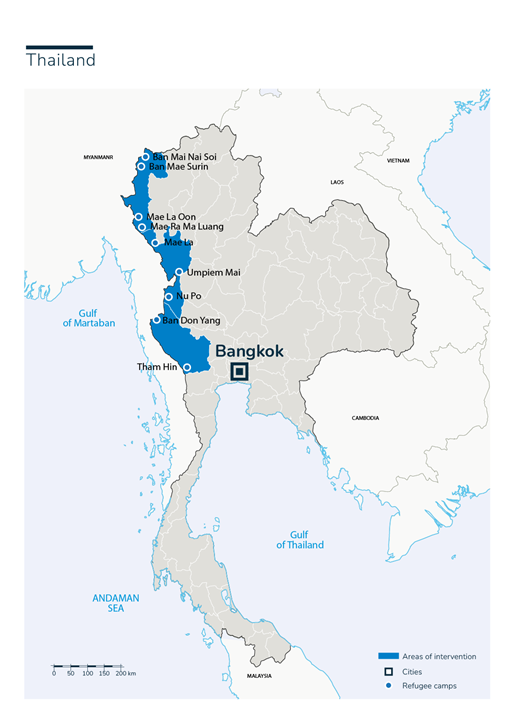
Thailand hosts large numbers of refugees from Myanmar. HI works in refugee camps, providing essential services to people with disabilities, improving their living conditions, and promoting the inclusion of impacted communities and people with disabilities in their communities.

Supporting an amputee, Thailand - Humanity & Inclusion | © Erika Pineros / HI
Our actions
In Thailand, HI supports refugees from neighboring Myanmar. Its activities enable them to access essential services such as healthcare, education, safe drinking water, and rehabilitation care. Furthermore, HI promotes the economic inclusion of refugees and people with disabilities by facilitating access to legal employment, particularly by developing their skills and supporting their entry into the labor market.
Following policy changes introduced by the Royal Thai Government in October 2025, HI is supporting the transition towards greater refugee self-reliance. Refugees registered with the Department of Provincial Administration (DOPA) may now seek legal employment outside temporary shelters, creating new opportunities for livelihoods and economic integration. HI also works closely with the Ministry of Public Health (MoPH) and other government stakeholders to support the gradual transition of rehabilitation and health services from humanitarian actors to national systems. As the Government continues to discuss policy measures to facilitate refugees' access to Thailand's public health insurance scheme, HI provides technical support to strengthen government capacity and ensure continuity of disability-inclusive rehabilitation services.
Through these interventions, HI supports both the immediate humanitarian needs of newly displaced populations and the long-term transition towards government-led, disability-inclusive health, rehabilitation and livelihood services.
This project aims to strengthen the resilience, well-being and independence of refugees, whilst reducing their long-term dependency and supporting their sustainable integration into national systems.
Areas of intervention


Latest stories

Powerful earthquake in Myanmar: HI assessments underway
A powerful 7.7-magnitude earthquake struck central Myanmar on Friday, March 28, according to the U.S. Geological Survey (USGS). HI, which is present in the country, is assessing the extent of the damage and preparing to intervene.

From Bangkok Dreams to Upcountry Scars: A Single Mom's Fight After Loss
As an active participant in Humanity & Inclusion's Disability Social Inclusion (DSI) program and Self Help Groups (SHG), Tha Zin Aye financially supports both herself and her son by farming mushrooms.

Kay Reh injured by an explosive device as he worked in a field in Thailand
Since 2012, Humanity & Inclusion has provided some 13,000 people living in nine refugee camps along the Thai-Myanmar border with information on the risks from explosive devices.
a life
Background
Thailand’s economy is generally stable but marked by persistent social and political weaknesses. Around 6–10 percent of the population remains in relative poverty, with significant disparities between urban and rural areas. Rural communities in the North and North-East are most affected, particularly because of limited access to healthcare, education, and stable employment.
Politically, the country has experienced prolonged instability. The aftermath of the 2023 elections and tensions between institutions, the military, and democratic movements continued to fuel uncertainty in 2024. Restrictions on freedom of expression and civil society mobilization remain key issues for NGOs, particularly regarding human rights and civic participation.
Thailand continues to be significantly affected by the ongoing conflict in neighboring Myanmar. Continued fighting and insecurity have resulted in regular cross-border movements of people seeking safety and humanitarian assistance in Thailand. New arrivals continue to require access to shelter, healthcare, rehabilitation services, psychosocial support and protection, particularly people with disabilities, older people and people with conflict-related injuries.
At the same time, intermittent tensions along the Thailand-Cambodia border have disrupted cross-border trade and labor mobility, prompting the Government to strengthen border security and humanitarian preparedness while maintaining humanitarian protection for displaced populations.
Economically, growth (around 2.5–3 percent) was held back by an uneven tourism recovery and high household debt. The informal sector remains highly developed, leaving a large proportion of the population exposed to economic shocks. Thailand also remains a destination and transit country for migrants, particularly those from Myanmar and Cambodia.
Thailand is also experiencing a rapid demographic transition towards an aging society. The shrinking working-age population has created labor shortages across key sectors, including agriculture, manufacturing, construction, healthcare and services. Labor shortages have been further affected by reduced cross-border labor mobility, particularly from Cambodia following recent border tensions. Recognizing these challenges, the Royal Thai Government introduced a policy in October 2025 allowing refugees registered with the Department of Provincial Administration (DOPA) to seek legal employment outside temporary shelters. This policy promotes refugee self-reliance, helps address labor shortages, and supports Thailand's economic development.
In parallel, the Government is discussing policy measures to facilitate refugees' access to Thailand's public health insurance scheme under the Ministry of Public Health (MoPH). These reforms are aligned with the Ministry of Interior's (MoI) 10-year Strategic Roadmap for Refugee Management, which aims to transition from humanitarian assistance to self-reliance through three phases: (1) promoting legal employment and self-reliance within 1-2 years; (2) consolidating temporary shelters from nine to five while strengthening government - led services within 3-5 years; and (3) gradually closing the remaining shelters and integrating refugees into national systems over the next decade within 10 years.
Environmental risks pose a major challenge. In 2024 - 2025, Thailand experienced seasonal flooding and periods of drought, affecting agricultural production and food security in certain regions. Climate change is exacerbating the helplessness of smallholder farmers.
The population often faces precarious working conditions and limited access to basic services, making this a priority area for humanitarian organizations.
- Population: 71 million
- HDI: 0.803 (2024)
- GDP: 526.52 billion USD (2024)
- GDP per capita: USD 7,346.6