Tunisia
In Tunisia, HI works to promote inclusion of people with disabilities, women, and those with the lowest incomes.

Economic inclusion project. Amani, who has a hearing impairment, was recruited in a clothing company in Gafsa. | © W. Hadhak / HI
Our actions
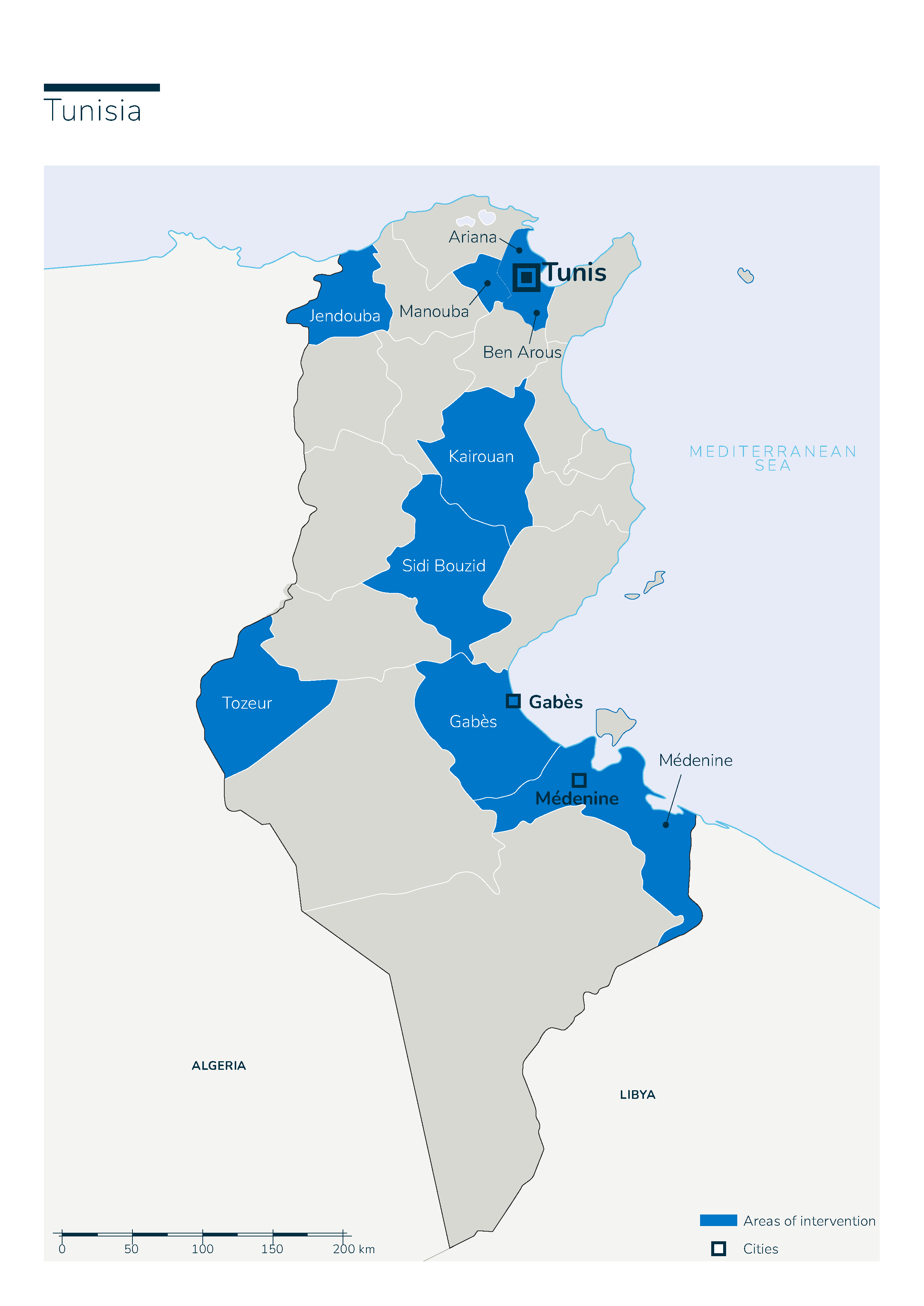
In Sfax, Madhia and Tunis, HI is working to improve the social and professional inclusion of people with disabilities by facilitating their access to inclusive vocational training in the sectors of photovoltaic systems, telecommunications, and fiber optics, in partnership with the Orange Foundation.
HI also works to combat poverty and promote social inclusion by supporting the development of support and management practices within voluntary and public social services. HI’s work takes various forms, including training, the joint development of operational standards and support tools for social work, and the funding of pilot programs aimed at individuals and families, enabling professionals to put into practice the lessons learned from the social engineering initiatives developed as part of the project.
In the field of social protection, HI works to improve access to social protection for women with disabilities by raising awareness among relevant stakeholders about the realities faced by these women and the challenges they encounter.
Finally, HI is supporting two organizations in Médenine and Tozeur that work with young people on the autism spectrum, with the goal of strengthening their educational and socio-professional inclusion pathways.
- Number of HI staff: 13 people
- Number of people directly supported by HI in 2025: 2,043 people
- Number of people indirectly supported by HI’s work in 2025: 4,964 people
- Program launch date: 1992
Areas of intervention

Latest stories

Use of banned explosive weapons at highest level since 2010
From Syria to Yemen, Afghanistan, Colombia, Myanmar and Tunisia, the use of banned explosive weapons increased significantly in 2014 and 2015. To mark International Day of Mine Awareness and Assistance in Mine Action, Handicap International is calling for an immediate end to the use of these weapons.
a life
Background
Tunisia is undergoing a multidimensional crisis, marked by economic, social, and political challenges that are weighing heavily on the population. The country is facing persistent inflation, particularly on food and essential items (petrol, sugar, flour, milk), exacerbating the precarious situation for many. This situation is made worse by high public debt (80% of GDP in 2024) and sluggish economic growth (+1.4% in 2025), which limit the state’s ability to meet social needs.
In addition to these structural socio-economic difficulties, there has been a cut in social and humanitarian funding, further restricting access to basic services for people who need them most.
- Population: 12.4 million
- HDI: 0.746 (2023)
- GDP: USD 51.2 billion (2024)
- GDP per capita: USD 4,181 (2024)