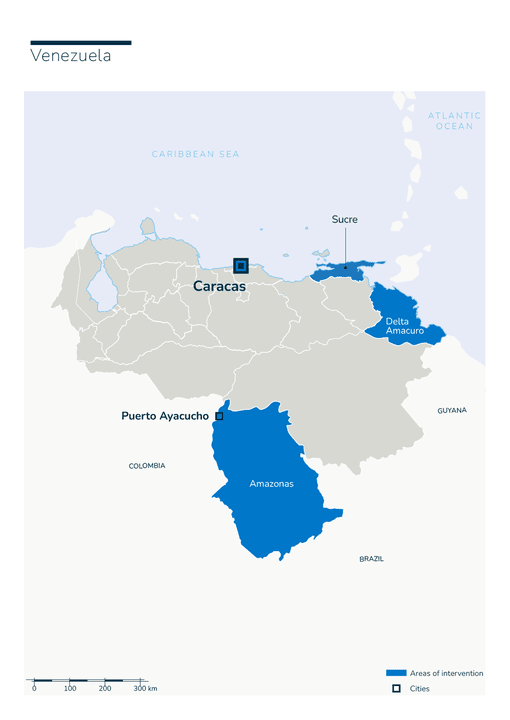
Venezuela
In Venezuela, HI works with indigenous communities and local stakeholders to improve living conditions and access to education for people with disabilities and other at-risk populations.
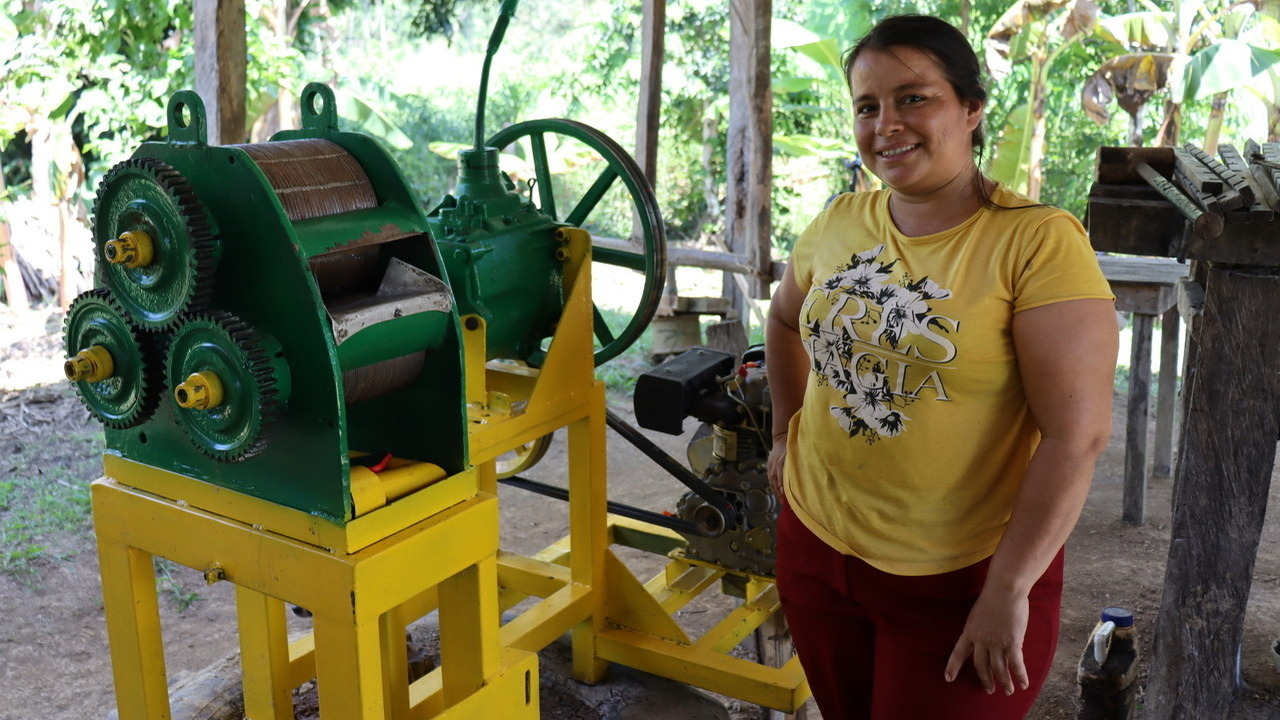
Thanks to her new mill, Luz will be able to increase her production of cane molasses. | © M. Campos / HI
Our actions
HI is responding to the deadly earthquakes in Venezuela. Donate today.
In Venezuela, HI works in the Amazonas and Delta Amacuro regions to improve access to education. HI enables children and young people to access safe, high-quality education and provides inclusive humanitarian assistance. Our teams provide comprehensive support, including mental health and psychosocial support through individual and group interventions; protection services such as inclusive case management, institutional strengthening, and the reinforcement of community-based protection mechanisms; and a water, sanitation and hygiene response that includes hygiene kits, awareness activities, household water treatment, and safe storage and sanitary infrastructure improvements. Assistance also includes food baskets, prevention activities for vector-borne diseases, and physical and functional rehabilitation.
Through playful and educational activities, HI supports children and their families by raising awareness and helping children stay in school or return to the education system. In addition, HI responds to emergencies, such as the water crisis in Sucre State, by providing urgent water, sanitation, hygiene, and food security assistance to affected communities.
We work with local authorities and community leaders to enable them to prevent, identify, and address risks of violence and anticipate needs arising from disasters. HI trains the community representatives so that they know how to respond to a disaster and can offer their communities tailored solutions that meet their needs. HI places particular emphasis on an inclusive approach, taking into account age, gender, and disability, to ensure that everyone receives appropriate support.
- Number of HI staff: 12 people
- Number of people directly supported by HI in 2025: 27,545 people
- Number of people indirectly supported by HI in 2025: 85,747 people
- Program launch date: 2019
Areas of intervention


Latest stories

Earthquakes in Venezuela: "The consequences will last more than ten years"
More than a month after the earthquakes, the needs of those affected are changing and becoming a part of their daily lives. Following its emergency response, HI is now implementing long-term support.

In Venezuela, HI is supporting people affected by the earthquakes
HI’s teams are continuing to support those affected by the disaster: through rehabilitation, mental health support, and the provision of essential supplies, help is being provided to those in need.

Venezuela: following the earthquakes, HI is providing care for the injured
Many people were injured in the earthquakes that struck Venezuela at the end of June. HI is providing them with emergency rehabilitation care.
a life
Background
Venezuela, a South American country with a population of 28.3 million, has been experiencing a major humanitarian, political, and socio-economic crisis for several years, marked by record inflation, widespread poverty, and mass population displacement. In 2026, more than 7.9 million Venezuelans are in need of urgent humanitarian aid – nearly a quarter of the population – while more than 8 million people have left the country since 2015.
Recurring political crises, including the dispute over the 2024 elections, international tensions, and the recent intervention by the United States in early 2026, have further weakened institutions. Despite a slight economic recovery in 2024–2025, the majority of the population lives in poverty: 56% of Venezuelans live in extreme poverty, with very limited access to basic services such as food and healthcare. Inequalities are widening, and essential public services (health, education, water, electricity) remain inadequate, exacerbating risk to the population. Disasters such as floods and landslides regularly worsen the situation, particularly in precarious rural and urban areas.
The humanitarian situation is critical, with priority needs in food security, health, protection, and access to drinking water. As a result, nearly 40% of the population suffers from food insecurity, and children are particularly affected by malnutrition and a lack of access to education. Furthermore, older people and people with disabilities, who are often overlooked, face major obstacles in accessing services and humanitarian aid. Despite legislative progress and national plans for the inclusion of people with disabilities, their situation remains a cause for concern, with a lack of adapted facilities and social protection.
- Population: 28.4 million
- HDI: 0.706 (2023)
- GDP: USD 119.8 billion (2024)
- GDP per capita: ~4,511 USD (2024)